

Avoid costly errors when ordering glass display cases
Buying or commissioning glass display cases is a high-stakes decision for retailers, museums, studios and homeowners. This article is a practical checklist you can use on site and in quotation reviews. It groups the most common specification gaps and supplier red flags into six themes: materials and safety, security and access, lighting and visibility, fit and installation, maintenance and conservation, and local supplier reliability. Use the questions and short guidance below to compare bids and avoid surprises. The keyword glass display cases is included so you can use this checklist during site visits or while comparing quotes.
Materials and safety checks
When to choose tempered or laminated glass
One common mistake is accepting vague glass descriptions such as "safety glass" without a standard. For retail and public displays demand tempered glass or laminated glass and ask which standard applies. Tempered glass breaks into small granular pieces and reduces laceration risk, while laminated glass holds together if damaged and is better for high security or valuable items. Industry guidance lists tempered and laminated panels as the expected safety options for display cases, so confirm the exact type on your spec sheet with the supplier's test or certification reference Houston Store Fixtures guide.
Where UV or anti-reflective glass matters
If your case will sit in natural light or display light-sensitive material, do not skip UV reduction or anti-reflective options. UV-protective glass significantly reduces ultraviolet transmission that fades textiles and paper, and anti-reflective coatings improve visibility for camera or customer viewing. These are material tradeoffs that should be specified, not assumed; suppliers and conservators recommend UV filtering and considering coatings when light exposure is present Gizmo Glass guide.
When acrylic is and is not suitable
Acrylic is lighter and less fragile than glass, and it can be useful for mobile or temporary cases. Do not choose acrylic for heavy shelving loads, high abrasion situations, or where long-term optical clarity is vital unless the supplier confirms scratch-resistant grades and appropriate thickness. The basic decision between acrylic and glass starts with matching the use case, mobility needs and weight limits before committing to a material Glass Retail Display guide.
Security and access: locks, keyed-alike and seals
Which lock types to confirm
Locks are not an afterthought. Ask for the exact lock model, cylinder grade and whether the lock is certified for retail use. Confirm whether the lock is keyed from the front, rear, or both, and whether it can be recessed. For high value items consider laminated glass with internal lock reinforcement. Practical question to ask: "What is the lock model number and can I see a product data sheet?" Industry checklists recommend keyed locks and keyed-alike options for multi-case installations Houston Store Fixtures guide.
Keyed-alike, master key and spare policy
If you are ordering multiple cases request the keyed-alike option and ask for spare keys with a documented policy for lost keys. For larger installations ask about master key systems and whether the supplier will register key blanks or provide a secure key control plan. Ask explicitly: "Can you provide keyed-alike cylinders and how many spare keys are included?"
Seals and gasket options for tamper resistance
For exhibit or museum use, sealed cases with continuous gaskets and tamper sensors matter. If humidity control or sealed environments are needed, confirm gasket material, ingress protection rating if available, and whether the door can be forced open when shelves are loaded. For archival exhibits additional protective measures such as sealed ports for silica gel are standard practice Gaylord exhibit case guide.
Lighting and visibility decisions
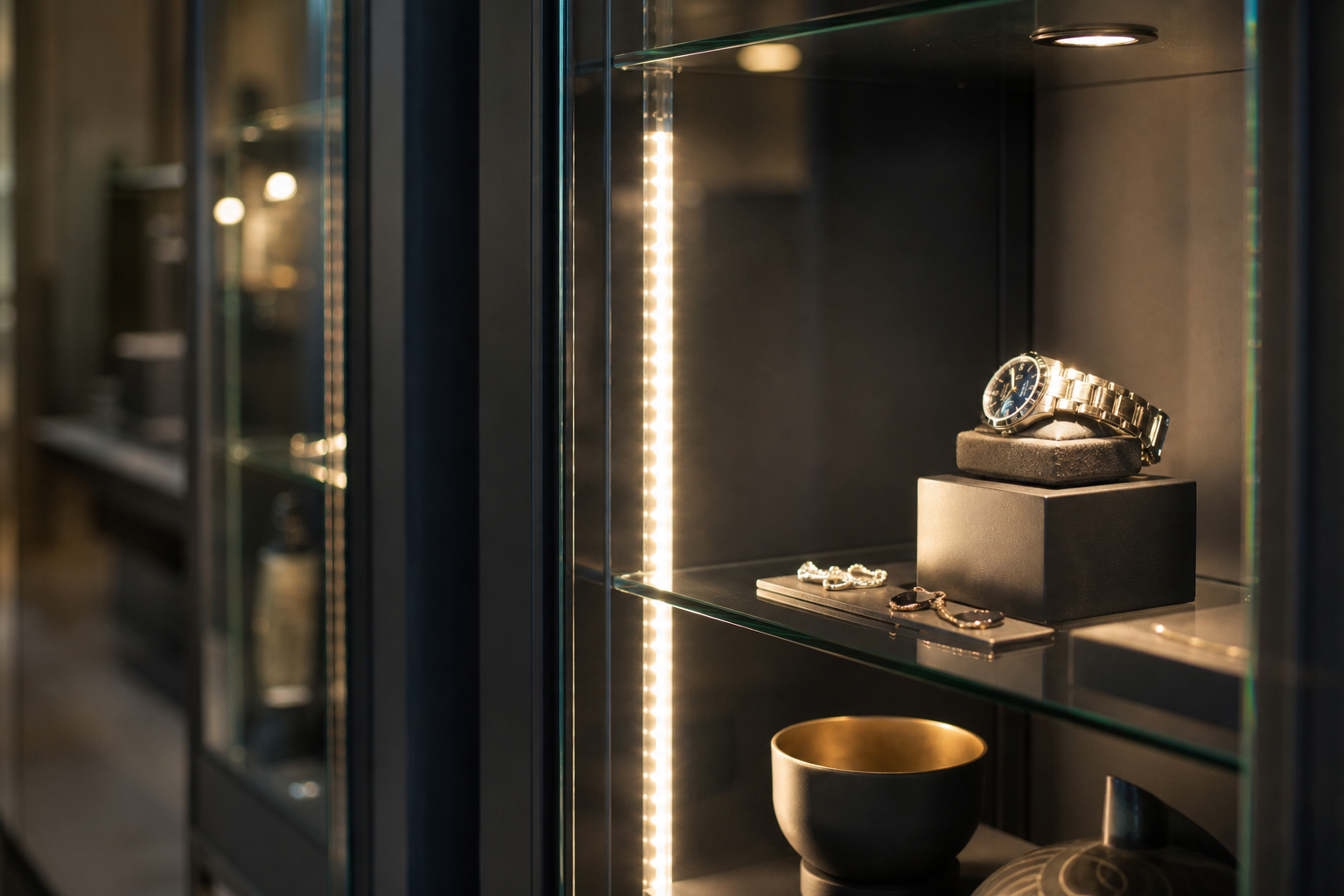
Recessed LED rails and heat management
Poor lighting spec causes hot spots, faded items and service headaches. Aim for recessed LED rails with documented heat output and a low UV emission profile. Ask for lumen values, colour temperature options and whether rails are replaceable without dismantling the entire case. Trusted suppliers list recessed LED rails and heat management features on their lighting specs Houston Store Fixtures guide.
Mirrored back versus anti-reflective glass
Mirrored back panels increase perceived depth but can cause distracting reflections for some products. Anti-reflective glass or matte backdrops improve readability for detailed objects. Clarify sightline priorities with this question: "Do you recommend a mirrored back, anti-reflective glass, or a non-reflective panel for my product range?"
Lighting serviceability and UV filtering
Ask whether lighting can be serviced without handling delicate items and whether the lighting includes integrated UV filtering in the LEDs or glass. Confirm dimming options and any recommended correlated colour temperature (CCT) range for your merchandise. If UV protection is required specify it in both the glass and the lighting components Gizmo Glass guide.
Fit, measurement and installation expectations
On-site measurement and templates you should expect
A frequent mistake is assuming the supplier will measure to the same level of care as a contractor. Demand an on-site measurement appointment and ask whether the installer will produce a physical template or digital drawings for you to approve before fabrication. Confirm who carries the measurement responsibility, whether the fabrication is based on your measurements or the supplier's, and whether templates are standard practice.
What installers should verify on arrival
Installers should check floor level, wall plumbness, adjacent fixtures and door swing clearances. They should bring hardware samples and a checklist for gaps, shims and anchoring. Ask: "What pre-install checks do you perform and will you document them in a site report?" OZ Shower Doors documents its end-to-end workflow, which includes on-site measurement, in-house production and scheduled installation, so confirm similar steps with any local fabricator OZ Shower Doors overview.
Common installation mistakes that cause problems
Watch for vague answers on how adapters, shims or trim will be handled. Misalignment, gap noise and poor sealing are common results of rushed installs. Confirm how adjustments are priced and whether the installer offers a punch list and post-installation follow up.
Maintenance, conservation and environment controls
Sealed cases, silica gel and humidity control
For fragile objects ask about sealed cases, silica gel compartments and humidity monitoring. Exhibit standards recommend sealed environments with desiccant management for sensitive collections. Ask the supplier for a maintenance schedule and whether they can supply periodic reconditioning or humidity checks Gaylord exhibit case guide.
Interior deck materials that avoid offgassing
Interior surfaces can offgas and damage artifacts. Ask what deck and base materials are used and whether they are accepted for conservation use. Require documentation of materials if you will display textiles, paper or works on sensitive substrates.
Cleaning and access procedures
Get written instructions for cleaning glass, interior panels and lighting, and confirm who is responsible for maintenance within the warranty period. Ask for a recommended cleaning product list and whether the supplier will train staff on safe handling of displayed items during cleaning.
Supplier reliability and local benefits for Edmonton projects

Local fabrication reduces lead time and makes on-site adjustments easier. Confirm whether the supplier manufactures locally and performs their own installations. OZ provides commercial glass shelving and display cases and full installation from an Edmonton facility, which shortens turnaround and simplifies adjustments glass shelving and display cases. When vetting local suppliers ask for recent Edmonton references, photos of comparable installs, and their scheduling protocol to reduce missed appointment risk.
Look for review themes such as consistent workmanship, clear communication and fair pricing. Red flags include vague specs, no reference photos, and a refusal to do on-site measurements or to provide a punch list after installation. Ask: "Can you provide three recent Edmonton project references and their contactable information?"
How to compare quotes: decision criteria and red flags
When comparing bids score them on these weighted criteria. Suggested weightings are shown so you can prioritise by need.
- Material and safety spec completeness, 25%: exact glass type, thickness, edgework and certification.
- Locks and keyed options, 15%: lock model, keyed-alike or master key, spare key policy.
- Lighting and visibility, 15%: lumen, CCT, dimming, replaceability and UV profile.
- Installation scope, 20%: who measures, templates, site checks, and adjustments included.
- Lead time and warranty, 15%: realistic lead time range and what warranty covers.
- Service and aftercare, 10%: scheduled maintenance, local repair capacity and response SLA.
Red flags to reject a quote are missing glass type, unspecified locks, no installation scope, no service SLA, or an unusually low price without itemised specs. Also be wary if a supplier cannot provide local references or photos of finished work in similar settings.
Printable decision checklist and next steps
Bring this one-page checklist to supplier meetings and site visits.
- Material: exact glass type and standard, thickness, edge finish confirmed.
- Safety: tempered or laminated specified and certification provided.
- UV and optics: UV protection and anti-reflective options noted if sunlight exposure exists.
- Alternative: acrylic suitability and thickness confirmed for mobile or temporary cases.
- Locks: lock model, keyed-alike, spare keys and master key options recorded.
- Seals: gasket type, ingress rating and silica gel port availability for exhibits.
- Lighting: LED rail spec, lumens, CCT, dimming and serviceability documented.
- Measurement: who measures, template provision and fabrication responsibility noted.
- Installation: on-site checks list, filler and shim policy, and punch list commitment.
- Maintenance: cleaning instructions, humidity control plan and warranty scope in writing.
- Local proof: ask for Edmonton references, recent photos, and confirmation of in-house fabrication.
Next steps: request a detailed specification sheet, an itemised quote, a project timeline, and three local references. If you want a fabricator who handles measurement, production and installation locally, request an on-site visit and template approval before fabrication. For a local option you can review OZ Shower Doors' commercial offering and request a quote glass shelving and display cases.
Frequently asked questions
Should I choose tempered or laminated glass for a display case
Choose tempered glass for general safety where breakage must avoid large shards. Choose laminated glass if you need the panel to remain intact after impact or you require higher security. Confirm the supplier's certification and whether laminated interlayer options include UV filtering Houston Store Fixtures guide.
Do display cases need locks and what keyed options exist
Yes, for retail and public settings locks are essential. Ask about lock model, keyed-alike options for multiple cases, master key configurations, and spare key policy. A clear lock specification is a must in the quote Glass Retail Display guide.
What lighting is best for retail display cases
Recessed LED rails with low heat output and a controllable CCT range are the usual choice. Confirm lumen output, dimming capability and whether lights can be serviced without disturbing displayed items Houston Store Fixtures guide.
Can acrylic replace glass for heavy or mobile display cases
Acrylic is lighter and resistant to shattering, so it is useful for mobile or temporary displays. It scratches more easily and may not support heavy shelving without thicker panels. Ask the supplier for thickness recommendations and scratch resistant coatings when considering acrylic Glass Retail Display guide.
What lead time and warranty items should I expect from a local installer
Lead times vary by material and workload. Expect a clear timeline for measurement, fabrication and installation. Request the warranty in writing and check it covers both workmanship and components. Local fabricators who also install will typically offer faster turnarounds and easier service, so confirm these points and ask for local references OZ Shower Doors overview.
Ready to compare detailed quotes or request an on-site measurement? Request a free consultation and quote from OZ Shower Doors at glass shelving and display cases.


